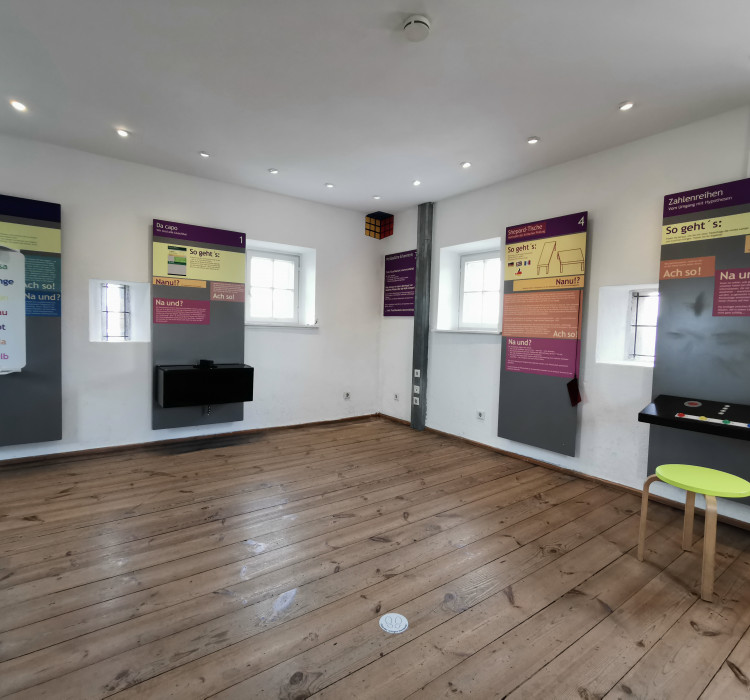
turmdersinneDas Hands-on-Museum zum Erleben, Staunen und Be-greifen |
We do not simply perceive the world - we construct it. Every waking moment our brains , via our sense organs, are bombarded with light and sound waves, aromatic molecules and the impact of physical objects on our skin. From these unpromising raw materials we create meaningful perceptions.
Usually these perceptions “make sense”, but in certain circumstances our brains can be tricked or deluded. We may see things that are not physically there, lose our normal sense of time and space or interpret ordinary things in a weird way. Our emotions, moods and preconceptions may alter what we see: happy people are more inclined to see smiling faces in a crowd while miserable people pass them over, for example; and a person who is given a glimpse of someone holding a half-obscured object are more likely to report the object as a gun if the person holding it is the type they have learned to associate with criminal behaviour.
In this talk we look at various perceiving “errors” and the superstitious or prejudiced ideas that they produce.
Download Slides Rita´s talk (pdf : 1,6 MB)
Rita Carter is a writer, broadcaster and lecturer who specialises in brain science. She has won many awards and her books are read throughout the world. These include “Mapping the Mind”, the first comprehensive layman’s guide to neuropsychology; “Exploring Consciousness”, “Mapping Memory” and “Multiplicity – the new science of personality”. She is currently working on a book charting the connections between genes, brain function and behaviour.
Rita began her career as a newspaper reporter, and subsequently worked in magazines, radio and TV. She co-presented London’s nightly news programme, “Thames News” for six years and produced and presented regular radio programmes about medicine and psychology. She continues to contribute to a wide range of TV and radio programmes and talks and lectures about brain science. Much of her work is dedicated to demonstrating how neuropsychology can be applied to day to day situations.
[Back to the program of "Science Meets Comedy" in German.]
turmdersinne im Web 2.0:
---------------------------------------------